


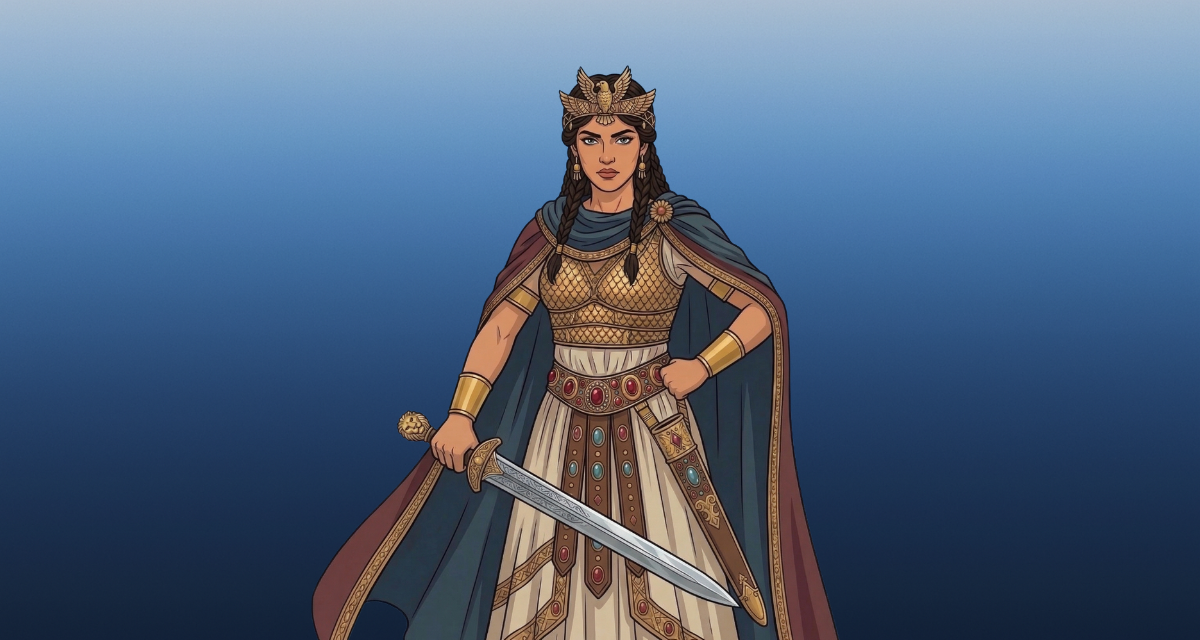
History usually drains the danger from women, leaving behind only the harmless images of queens or consorts. Zenobia broke this pattern as a ruler who made the Roman Empire, one of the most feared forces in history, feel the weight of her presence. She entered the chaos of the 3rd Century and expanded her reach until Rome was forced to acknowledge her. In an era where authority was defined by command, her place at the center of the world was a deliberate choice.
Following the assassination of her husband in 267 AD, Zenobia stepped into the political vacuum to consolidate her hold on Palmyra. She used the instability of the Roman leadership to turn her city into the capital of a movement that would soon dominate the East. This was the start of a rapid expansion that moved far beyond the borders of a local city-state.
Her annexation of Egypt in 270 AD gave her control over the grain supply that kept Rome alive. She led her armies across Syria, Palestine, and Anatolia, absorbing territories until her borders reached the Black Sea. She systematically dismantled the Roman administration, replacing it with a government that answered only to her.
Within Palmyra, Zenobia built an intellectual environment that rivaled the centers of Athens and Alexandria. She surrounded herself with scholars like Cassius Longinus, creating a court where intellectual life was as sharp as the military. She was a scholar herself, fluent in Aramaic, Egyptian, and Greek, using this knowledge to govern a diverse population with a sophistication that few others could match.
By declaring herself Augusta and her son Augustus, Zenobia formally ended the illusion of Roman supremacy. She issued her own currency and established a bureaucracy that worked with an efficiency Rome could no longer reach. This total rejection of the existing order made her an existential threat. It eventually forced the Emperor Aurelian to lead a massive military campaign to reclaim what she had taken.
Zenobia represents a form of empowerment that existed long before the modern language used to describe it. She functioned entirely beyond the structures designed to exclude her. In a world that kept women away from the mechanics of rule, she became the rule itself. Her leadership suggests that influence is not always something to be negotiated or granted by others. She stands as a model of power that is claimed and enforced, moving far outside the narrow stories history usually allows women to occupy. Her life is a reminder that once power is taken, the impact remains long after the empire falls.






























0 Comments