
Close
by Lucy Harker | Oct 22, 2026
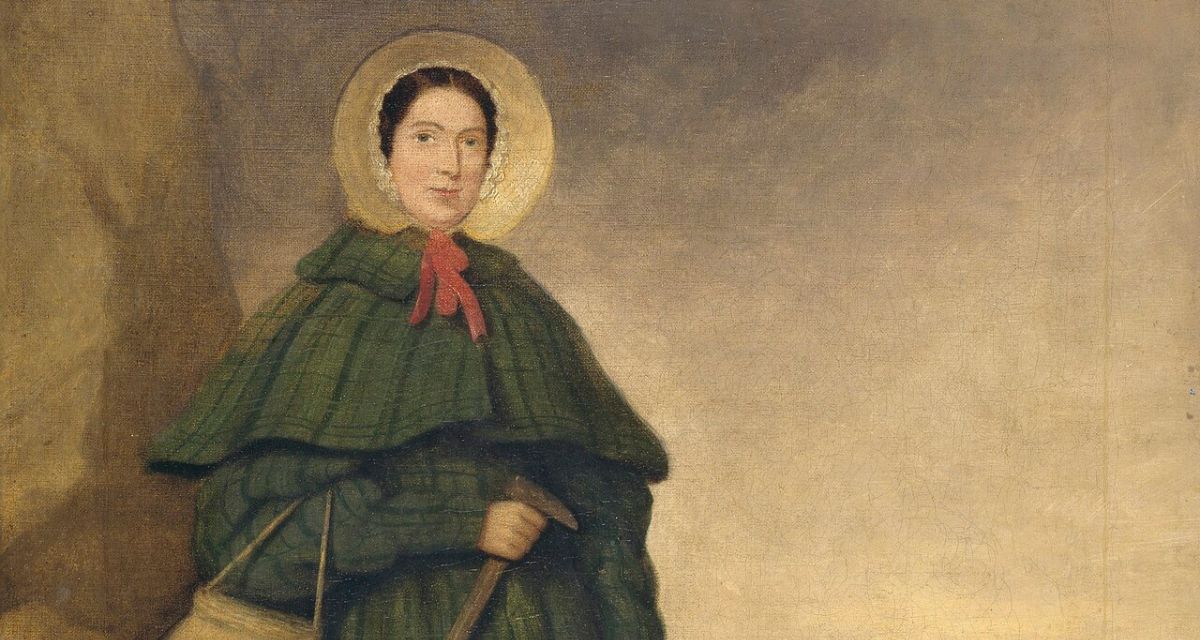
There was a time when discovering something extraordinary wasn’t necessarily enough to make you a scientist. In nineteenth-century England, the scientific world was largely a gentlemen’s club, populated by educated men with the money, connections, and social standing to pursue their interests. Women were generally expected to occupy themselves elsewhere, and those born into poverty had even less chance of being taken seriously. Never mind that nature had no particular preference for wealthy men. The institutions studying it certainly did. And somewhere along the southern coast of England, a young woman named Mary Anning was about to give those gentlemen quite a lot to think about.
Mary was born in 1799 in Lyme Regis, a coastal town in Dorset, where her father, Richard Anning, worked as a carpenter and collected fossils to sell to visitors. He taught Mary and her older brother Joseph how to find and clean the strange objects that washed out of the surrounding cliffs. The family had very little money, and when Richard died in 1810, things became considerably worse. Mary had received little formal education, but she’d spent much of her childhood searching the coastline with her father. Fossils were a source of income, though she was becoming increasingly interested in understanding what they actually were.
In the autumn of 1811, Joseph found the skull of an enormous prehistoric creature. Mary went looking for the rest and, in 1812, began excavating a skeleton roughly five metres long. She was only twelve years old. The animal was an ichthyosaur, a marine reptile that had lived millions of years earlier, and the specimen became one of the first largely complete examples to attract serious scientific attention. It was an extraordinary find for anyone, let alone a child who had learned her trade on the beach. While established scientists had libraries, collections, and academic connections at their disposal, Mary was digging through the cliffs of Lyme Regis and discovering creatures that nobody alive had ever seen.
And she was only getting started.
On December 10, 1823, Mary discovered an almost complete plesiosaur skeleton. Unlike the ichthyosaur, this creature had a remarkably long neck, a small head, and proportions that seemed almost impossible. So impossible, in fact, that Georges Cuvier, one of Europe’s leading naturalists, suspected the skeleton might be a fraud, assembled from pieces of different animals. The discovery attracted considerable attention, and in February 1824, the Geological Society of London gathered to examine and discuss the specimen. Mary wasn’t there. She had found it, excavated it, and supplied the drawings that helped scientists study it, but women weren’t admitted to the Society’s meetings.
Cuvier eventually accepted the specimen as genuine after further evidence was presented. Mary’s plesiosaur was real, no matter how improbable it looked. To be fair, questioning an unusual discovery is exactly what scientists should do. Cuvier had every reason to investigate a creature unlike anything previously known. The strange part is that the woman with firsthand knowledge of the fossil couldn’t take part in the discussion. Her discovery could enter the room, apparently. She couldn’t.
By then, Mary had become much more than someone who collected unusual objects to sell. In 1828, she found the first pterosaur skeleton identified outside Germany. She discovered fossil fish and helped researchers understand coprolites, which are fossilized droppings. They might not sound particularly glamorous, but they provided valuable evidence of what prehistoric animals ate. Her knowledge of anatomy and the fossils found around Lyme Regis grew through years of observation, and scientists began visiting her to examine specimens, discuss discoveries, and purchase fossils for their collections. Some travelled considerable distances because Mary knew things they wanted to learn.
Yet the Geological Society of London remained closed to her. It wasn’t until 1919 that women could become Fellows, seventy-two years after Mary’s death. The men who worked with her weren’t all dismissive, of course. Henry De la Beche, a geologist and longtime friend, respected her work and helped her financially. Others sought her advice and acknowledged her expertise. But some researchers published findings based on fossils she had discovered without properly crediting her. Whatever individual scientists thought of Mary, the rules governing their institutions were another matter. She could contribute to the work, provide the evidence, and answer their questions. Becoming one of them was apparently asking too much.
Mary wasn’t always content to let the published experts have the last word, either.
In 1839, Edward Charlesworth, editor of the Magazine of Natural History, published a description of a fossil shark called Hybodus. Mary had discovered the fossil jaw he was discussing, and when Charlesworth asked her for information, she pointed out that the feature being described was hardly new. She had encountered similar specimens before and discussed them with the naturalist Louis Agassiz. Her response was published in the journal, making it the only scientific contribution known to have appeared under her name during her lifetime. Charlesworth replied rather dismissively, suggesting that her interpretation was mistaken. One can only imagine how much that impressed a woman who had spent decades examining the very fossils under discussion.
The exchange was relatively small, but it says something about Mary that her famous discoveries alone cannot. She wasn’t merely supplying specimens for better-educated men to interpret. She understood what she was finding and had developed opinions based on her own experience. When she believed a published account needed correcting, she said so. She had no university degree to lend authority to her words, although considering what she had already discovered, that seems a rather poor way to measure what she knew.
For all her accomplishments, Mary never enjoyed much financial security. Fossil hunting wasn’t a hobby she could afford to abandon whenever business was slow. It was how she earned her living, and even the most remarkable discoveries didn’t necessarily pay enough to keep her comfortable. Friends and supporters helped her during difficult periods, but money remained a concern. There was a rather cruel imbalance between the scientific importance of her work and the financial rewards she received for it. Fossils that would eventually become treasured museum specimens had first passed through the hands of a woman trying to earn enough to live.
Mary died of breast cancer on March 9, 1847, at the age of forty-seven. Henry De la Beche later paid tribute to her in the Quarterly Journal of the Geological Society, giving recognition to a woman who had never been eligible to join the institution. Her discoveries continued to inform the developing science of paleontology, particularly the study of prehistoric animals and extinction. By the time the Geological Society finally admitted women as Fellows in 1919, Mary had been dead for more than seven decades.
It’s tempting to look at her story and celebrate how far science has come. And there certainly is something worth celebrating in the life of a woman who taught herself to understand creatures buried for millions of years beneath the English coast. But that doesn’t make the circumstances of her career any less frustrating. Mary didn’t spend her life campaigning to change the rules of scientific institutions. She was busy working, learning, and earning a living. Her discoveries were enough to attract the attention of some of the most respected scientists in Europe, yet they couldn’t open the doors that her sex and social class kept closed. She left behind evidence that changed what people knew about the history of life on Earth. The people in charge were fortunate she never waited for their permission.


















0 Comments