


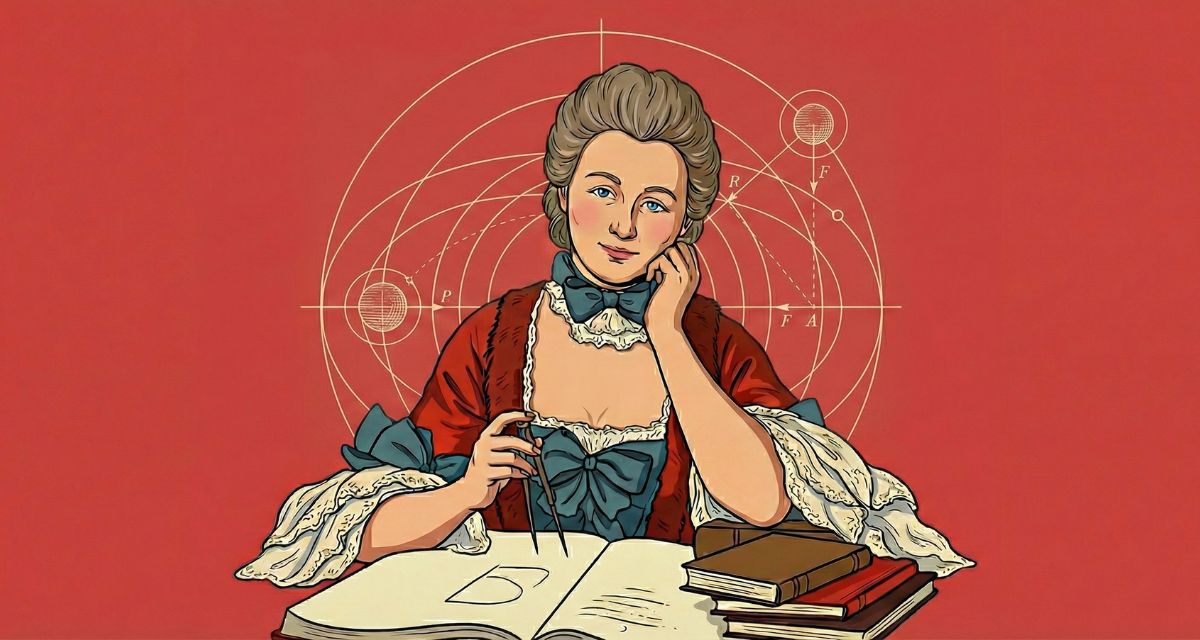
When people talk about the foundations of modern science, the same names tend to appear. Newton. Galileo. Sometimes Voltaire, positioned as the public face of the Enlightenment. What rarely comes up is the woman whose work helped define how Europe understood physics at all. Émilie du Châtelet did not orbit these men or exist at the edges of their achievements. She worked alongside them, argued with them, and in some cases corrected them.
She lived in eighteenth-century France, a world where science was formal, exclusive, and openly hostile to women. Universities were closed to her, and scientific institutions were not designed to include her. None of this stopped her from becoming one of the most serious scientific thinkers of her time.
Du Châtelet trained rigorously in mathematics and physics, hiring tutors and devoting herself to subjects women were expected to admire from a distance, if at all. She approached science as disciplined work, not as a pastime or social ornament. Through correspondence and collaboration, she engaged directly with leading European scientists and earned their respect through precision and depth rather than novelty.
Her most influential contribution was her French translation of Isaac Newton’s Principia. This was not a neutral or mechanical task. Newton’s original text was notoriously dense and inaccessible, even to trained scholars. Du Châtelet restructured its arguments, clarified its concepts, and added extensive commentary that guided readers through its logic. In doing so, she played a foundational role in how Newtonian physics was understood, taught, and debated across Europe.
That translation remains the standard French edition today, meaning that generations of readers have encountered Newton through her intellectual framing.
Alongside this, du Châtelet produced original scientific work, particularly on the nature of energy and motion. At a time when many scientists treated Newton’s ideas as settled doctrine, she was willing to question them and argue for alternative interpretations. She participated fully in scientific debate and was unafraid to disagree when she believed the evidence demanded it.
She published under her own name, argued publicly, and claimed intellectual authority in a field that defined authority as male. Her presence was practical rather than symbolic, grounded in work that shaped debates and outcomes rather than representation. She refused to treat knowledge as a gendered possession and operated as though access to science required no permission.
During her lifetime, her work was respected and cited. After her death, it was gradually absorbed into the broader narrative of Enlightenment science. Her ideas continued to shape the field, while her name became less visible, folded into a story that favored male lineage over intellectual contribution.
Émilie du Châtelet shaped the intellectual structure of modern physics in ways that remain in use today. Her work needs no reinterpretation to justify its importance. Its clarity, rigor, and authority speak for themselves.




































0 Comments