
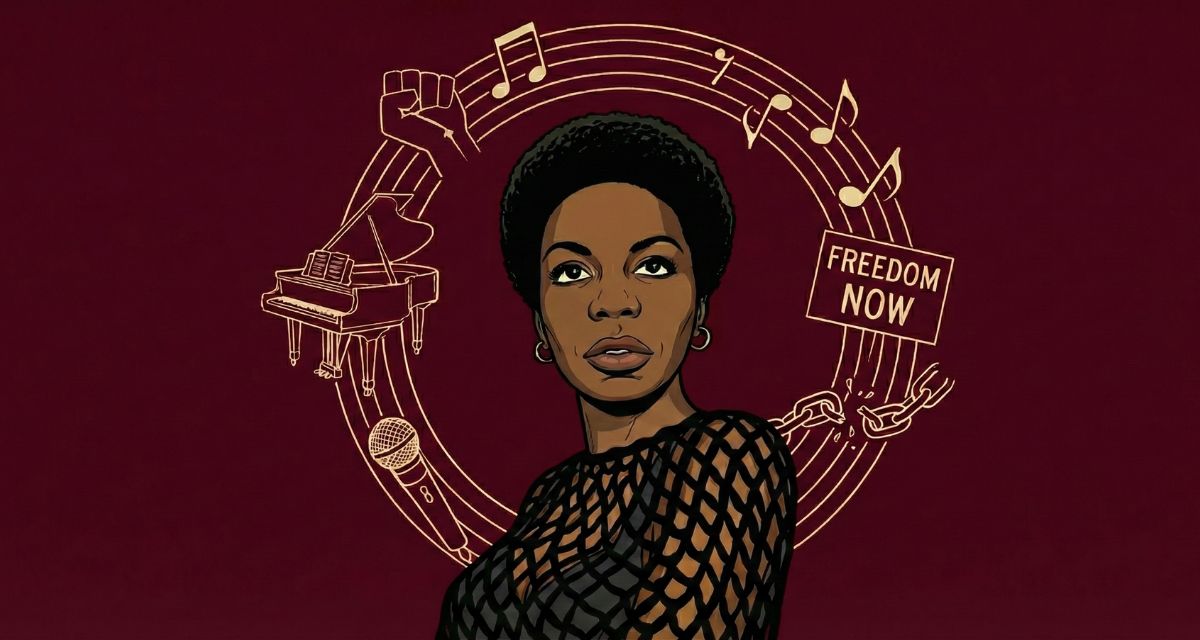
People love to tell artists to “stick to the music,” as if melodies exist in a vacuum, untethered from the world that bleeds into them. They want the song, but they don’t want the soul behind it, especially when that soul has something uncomfortable to say. But art has never been a vacuum. It is a mirror, and sometimes the reflection is jagged. If you want to understand what it looks like when a creator refuses to blink, you have to look at Nina Simone.
Nina was a technician of the sublime who carried the weight of a classical education into a world that tried to lock its doors. When the prestigious institutions rejected her, not because of her talent, but because of her skin, she took that cold, technical perfection and bled it into jazz and blues. She created a genre that didn’t have a name yet, built entirely on her own terms. She commanded her notes with a terrifying precision, where every lyric was a deliberate choice, and every silence in her performance felt like a sharp edge. She held total authority over the air in the room.
In an era where performers were expected to be “safe” to keep their careers alive, Nina chose to be dangerous. She saw the world breaking and refused to pretend it was whole. After the murder of Medgar Evers and the Birmingham church bombing, she didn’t write a polite letter of protest. She wrote “Mississippi Goddam.” She used works like “Backlash Blues” and “Four Women” to dissect systemic racism and the suffocating stereotypes placed on Black women. She sang about police violence and economic chains at a time when the radio only wanted love songs.
She understood the gravity of those choices. Her defiance cost her airplay, venues, and money, yet she remained indifferent to the loss of status. She traded the hollow comfort of a mainstream career for the heavy authority of her own conviction. She refused to soften the blow just so the audience could sleep better at night.
Nina Simone’s legacy is a blueprint for how to exist as an artist without losing your pulse. She proved that a woman could hold absolute power over her craft and her politics simultaneously. She remains a haunting presence for the uncompromising, vibrating in every artist who knows that if your craft doesn’t stand for something, it is just noise. She claimed her power in a world that tried to keep her small, and she lived completely in charge of her own shadow.




















0 Comments