
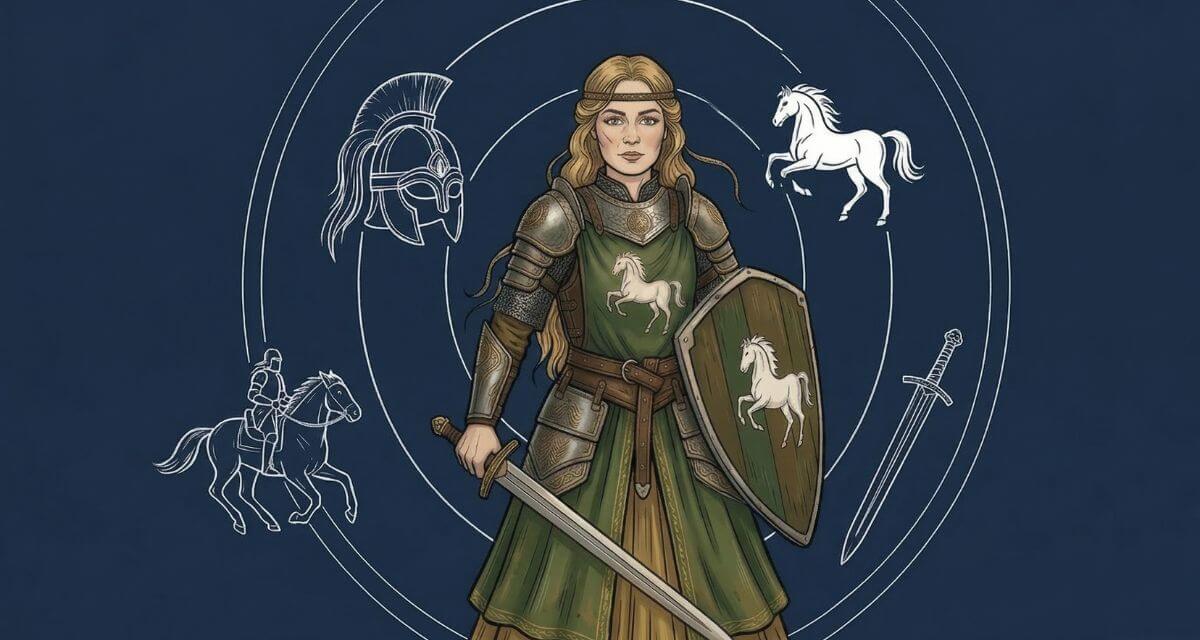
The works of J. R. R. Tolkien are often criticized for the rarity of women in his legendarium. While female characters appear less frequently than men, the women Tolkien created often carry a strong, empowering, and even feminist element. Rather than objectifying them, Tolkien wrote women who possess autonomy, dignity, and influence within their societies. Many of them hold important roles in the story and challenge the expectations placed upon them, pushing against the rules of their fictional world in ways that sometimes mirror struggles found in our own. In this She’s In Charge entry, we talk about one of the most prominent female characters in Tolkien’s legendarium, Éowyn.
Éowyn first appears in The Two Towers as a noblewoman of Rohan, the niece of King Théoden and sister of Éomer. After the deaths of her parents, she and her brother were raised in the king’s household. When the story reaches Rohan, Éowyn has spent years caring for her uncle while he suffers under the corrupting influence of Saruman and his servant Gríma Wormtongue. Even in this constrained position, she is respected for her courage and strength. When Théoden prepares to ride to war after his recovery, he entrusts Éowyn with the leadership of the people of Rohan, sending her to guide them to safety in the mountains while the army faces Saruman’s forces.
Her most famous actions take place in The Return of the King. Refusing to accept the command to remain behind while the men ride to battle, Éowyn disguises herself as a warrior named Dernhelm and secretly rides with the Rohirrim to Minas Tirith, bringing the hobbit Merry with her. During the Battle of the Pelennor Fields, she faces the Witch-king of Angmar, leader of the Nazgûl, who believes himself invincible because of a prophecy that no man can kill him. Revealing her identity, Éowyn strikes down the Witch-king, the most powerful force in Middle-earth after Sauron himself. With the assistance of Merry, whose own strike with a blade of Westernesse made the Nazgûl vulnerable, she fulfills the prophecy. Gravely wounded in the battle, she is taken to the Houses of Healing, where she recovers. After the war, she chooses a different path, finding peace in Ithilien with Faramir and turning away from her earlier desire for glory in battle.
The character of Éowyn resonates with many readers because her struggle is not only against the enemies of Middle-earth, but also against the expectations placed upon her as a woman in the society of Rohan. Throughout The Lord of the Rings, Éowyn is repeatedly told that her role is to remain behind while the men ride to war. Though respected, she is still confined by tradition. Her frustration comes from a desire to act and to stand beside her people in the fight for their future. By disguising herself and riding to battle, Éowyn rejects those limits and claims the right to decide her own role.
Her confrontation with the Witch-king of Angmar during the Battle of the Pelennor Fields becomes the defining moment of that defiance. When the Nazgûl lord claims that no man can kill him, Éowyn proves that courage and heroism are not bound by gender. This moment is more than a dramatic victory in the story; it represents the breaking of a rule that both the prophecy and her society seemed to enforce. For many readers, this act of courage, combined with her determination to shape her own life, is what makes Éowyn one of the most empowering female characters in Tolkien’s legendarium.
Stories like this endure because the struggles they reflect are still present in the real world. Women today continue to face barriers in leadership, careers, and societal expectations that try to define what they can or cannot pursue. Éowyn’s example reminds women that challenging those limits requires courage. Whether in literature or in life, progress often begins when women refuse to accept the roles others assign and instead claim their own path forward.



















0 Comments