
Close
by Lucy Harker | Oct 29, 2026
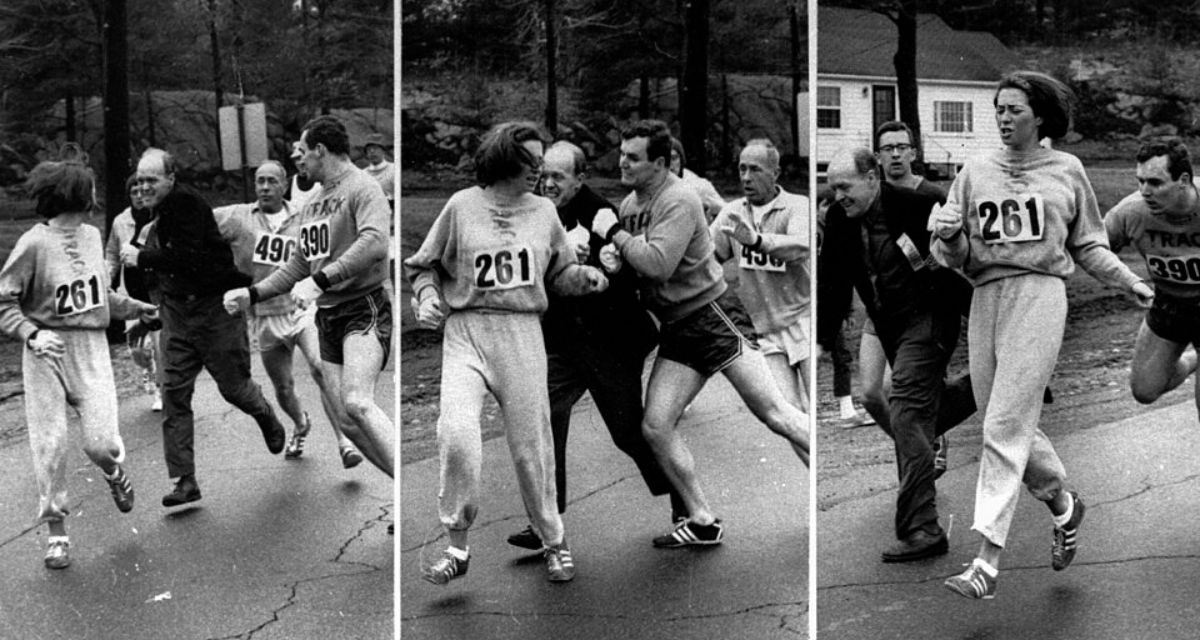
We often talk about women being held back. By traditions, expectations, outdated beliefs, and men who seem personally offended by the idea of equality. Usually, we’re speaking figuratively. In 1967, during the Boston Marathon, a race official apparently decided to take the expression a little too literally. He ran after a twenty-year-old woman in the middle of the race and tried to tear the number off her chest. Her crime? Running. And doing so with the audacity of being a woman. Her name was Kathrine Switzer, and she had absolutely no intention of stopping.
At the time, long-distance running was largely considered unsuitable for women. There were widespread beliefs that their bodies couldn’t handle the physical demands of a marathon, and competitive opportunities reflected those assumptions. The longest women’s running event at the Olympic Games was just 800 metres. A full marathon was 42.195 kilometres, or 26.2 miles, which apparently sounded like a perfectly reasonable distance for men but something dangerously ambitious for women. The scientific explanation for this distinction? “Because I said so, that’s why.”
Some women had already begun proving those assumptions wrong. In 1966, Roberta “Bobbi” Gibb ran the Boston Marathon without an official entry after being denied permission to compete. She finished in three hours and twenty-one minutes, ahead of a considerable number of male participants. It was a remarkable achievement, but the race still didn’t officially welcome women. The following year, another young runner decided she wanted to participate. Kathrine Switzer was a journalism student at Syracuse University who trained with the men’s cross-country team. She had been preparing for the marathon with her coach, Arnie Briggs, and wanted her performance to count. So she registered properly, signing her application as K. V. Switzer, the name she ordinarily used. There was no question about sex on the form and no explicit rule stating that women couldn’t enter. Her application was accepted, and she received bib number 261.
On April 19, 1967, Kathrine joined the runners at the Boston Marathon. It was a cold, miserable day, with snow and sleet falling over the course. She wore a baggy sweatshirt to stay warm, accompanied by her coach, her boyfriend Tom Miller, and another runner. For the first few kilometres, things went relatively normally. Then race co-director Jock Semple noticed her.
Semple was furious that a woman had entered the race with an official number. He ran toward Kathrine, shouting at her to get out and give him the numbers, before attempting to grab her bib and remove her from the competition. Tom Miller intervened, knocking Semple away while Kathrine continued running. Photographers nearby captured the confrontation, producing one of the most recognizable images in the history of women’s sports. There is something almost comical about a man becoming so angry at the sight of a woman running that he decides to chase her down. Almost. The photograph is funny until you remember that he really was trying to stop her.
Kathrine was shaken by the incident. She later recalled feeling frightened and humiliated, and for a moment she considered quitting. But she also realized what abandoning the race might mean. If she stopped, the people who believed women didn’t belong in marathons would have another excuse to dismiss them. So she kept going. Four hours and twenty minutes after starting, Kathrine completed the Boston Marathon. The official who had tried to remove her didn’t get his way, and the photographs of his attempt were soon travelling around the world.
It’s important to remember that Kathrine wasn’t the first woman to run the Boston Marathon. Bobbi Gibb had done that the previous year and was running again in 1967. Kathrine was the first woman to enter and finish with an official race number. That distinction doesn’t make either achievement less significant. Gibb had demonstrated that women could complete the distance, while Kathrine exposed the absurdity of a system that could issue a woman an official number and then try to physically remove her for wearing it. Different actions, the same ridiculous barrier.
What happened in Boston changed Kathrine’s relationship with running. She hadn’t entered the race intending to become a symbol of women’s equality. She wanted to run a marathon. But once she understood how strongly the sporting establishment resisted women’s participation, finishing races was no longer enough. She began campaigning for women to have proper opportunities to compete, helping build the movement that eventually opened major distance-running events to female athletes.
In 1972, five years after the infamous incident, the Boston Marathon officially introduced a women’s division. Kathrine competed again, this time without anyone attempting to remove her from the course. In 1974, she won the women’s race at the New York City Marathon. The following year, she returned to Boston and finished second among the women, recording a personal best of 2:51:37. The woman who had supposedly been doing something beyond her physical capabilities was now competing at an elite level. One might think the results would have settled the argument rather decisively.
But Kathrine’s ambitions went further than her own performances. In 1977, she began developing the Avon International Running Circuit, a worldwide series of women’s running events. The program eventually organized hundreds of races across 27 countries and reached more than a million participants. It created opportunities for women to compete, gain experience, and demonstrate that there was enormous interest in distance running when women were actually allowed to take part. Alongside the work of other athletes and advocates, the circuit helped build the case for including a women’s marathon in the Olympic Games.
That finally happened at the 1984 Summer Olympics in Los Angeles. For the first time, women could compete in the Olympic marathon, ninety years after the men’s event had been introduced at the first modern Games in 1896. Ninety years. Apparently, the sporting world needed almost a century to establish that women were also capable of putting one foot in front of the other for a very long time. Kathrine was there, working as a television commentator for the historic race. She had gone from being chased off a marathon course to helping bring women’s marathon running to the world’s biggest sporting stage.
Her work didn’t end there. In 2015, Kathrine co-founded 261 Fearless, an organization that encourages women to develop confidence and independence through running. The name came from the number she wore in Boston, the very number Semple had tried to take away. What had once been the target of an angry official became a symbol shared by women who wanted to challenge their own limits.
Then, in April 2017, Kathrine returned to the Boston Marathon for the fiftieth anniversary of her historic run. She was seventy years old and wearing number 261 again. She finished in 4:44:31, only twenty-four minutes slower than she had been at twenty. The Boston Athletic Association retired her number in recognition of her contribution to the sport. Fifty years earlier, someone had tried to rip it off her. Now the organization was making sure nobody else would wear it in the race. It’s difficult to imagine a more satisfying way for that particular story to come full circle.
There is a temptation to reduce Kathrine Switzer’s story to a photograph of an angry man trying to stop a determined woman. It is an unforgettable image, but it represents only a few seconds of a much longer fight. Kathrine spent the decades that followed helping other women gain opportunities that had once been denied to her, and she was never the only woman fighting for those changes. Bobbi Gibb and many others deserve their place in that history. What makes Kathrine’s contribution so important isn’t simply that she refused to stop running in 1967. It’s that she understood how many women were still being told they couldn’t even start.
We talk about women being held back as though it is always an invisible force, something buried in social expectations or written into rules nobody wants to question. Sometimes it is. And sometimes it’s a man running after a woman, desperately trying to pull her out of a race she has every right to finish. Kathrine kept running that day. Then she spent much of her life making sure more women could run alongside her. They tried to hold her back, and she helped millions of women move forward.

























0 Comments