
Close
by Lucy Harker | Nov 5, 2026
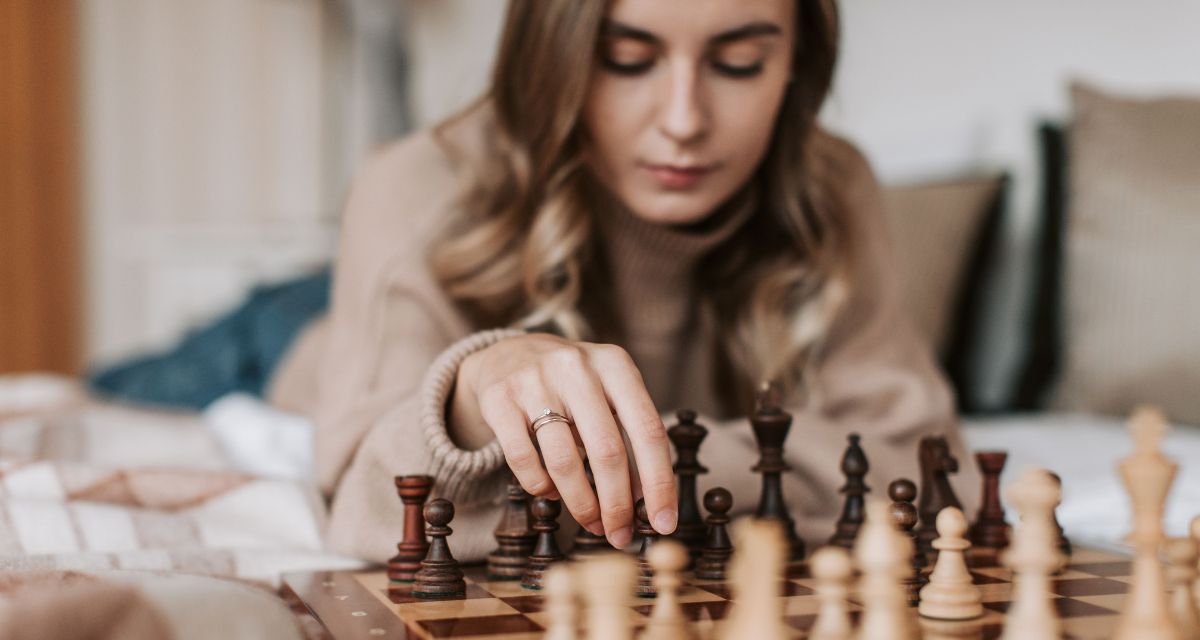
Chess has never made much effort to explain itself to outsiders. You watch two people sit in silence for half an hour, someone moves a knight, and the commentator reacts as though there’s been a death in the family. Apparently, this is excitement. I’m sure it is, if you understand what’s happening. But lately, chess has been finding its way out of those silent tournament halls and into the considerably noisier world of social media. Players argue with their viewers, laugh at their own mistakes, and occasionally lose a queen in front of thousands of people. Some of the biggest audiences are following women who have spent years mastering the game and are now letting the rest of us see what makes it worth playing.
The pandemic probably deserves some credit for the renewed interest in chess. People were stuck at home with more free time than they knew what to do with, and Netflix had just released The Queen’s Gambit, a 2020 miniseries about Beth Harmon, a fictional chess prodigy. I imagine quite a few people bought chessboards after watching it, only to discover that becoming a genius wasn’t quite as easy as Beth made it look. Luckily, there were plenty of people online willing to teach them. Anna Cramling, sisters Alexandra and Andrea Botez, Dina Belenkaya, Alexandra Prado Serrano, Julia Schulman, also known as Jules Gambit, and Nemo Zhou are among the women who have made a name for themselves in this world. And watching them play can be quite addictive, even when you have absolutely no idea why everyone is screaming about a bishop.
For Anna Cramling, chess has always been a family affair. Her parents are grandmasters Pia Cramling and Juan Manuel Bellón López, which must have made winning a casual game at home rather difficult. Anna went on to earn the Woman FIDE Master title and represent Sweden at the Chess Olympiad. Today, her mother frequently appears in her videos, and their conversations are often as interesting as the games themselves. Pia has spent decades competing against some of the strongest players in the world, yet she can still find herself explaining a position to her daughter while Anna stares at the board in disbelief. Anna argues, Pia explains, Anna asks another question, and sometimes they both end up laughing. Trying to win a chess argument with Pia Cramling sounds like an uphill battle. But watching them together, you can also see how much Anna enjoys having her there. Pia has known this game for most of her life. Now she’s sitting beside her daughter, discussing moves in front of an audience that might never have watched one of her tournaments.
The Botez sisters don’t seem particularly interested in chess’s reputation for silence. Alexandra is a Woman FIDE Master, and Andrea grew up playing competitively too, but put them together on a stream and a chess game can become a family argument in seconds. They challenge people, annoy each other, travel, and leave an impressive record of their worst moves on the internet. Julia Schulman, also known as Jules Gambit, had a different experience growing up. She started competing at five and went on to become Northern California girls’ champion. Then she stopped. She has talked about feeling lonely at tournaments, where making friends wasn’t easy. She was winning championships, surrounded by children who loved chess too, and still struggling to make friends. Julia eventually returned to chess through videos, where she shares her games, jokes, and mistakes with an audience. Those childhood tournaments could have done with a few friendly faces.
Alexandra Prado Serrano, known as AlexandraChess, grew up in Bolivia, earned the Woman Candidate Master title, and represented her country internationally. Now living in France, she makes videos about puzzles, tactics, and chess tricks, explaining moves that might otherwise leave beginners staring helplessly at their screens. Dina Belenkaya has become known for a different kind of encounter. A Woman Grandmaster and four-time women’s champion of Saint Petersburg, she often challenges people to games in public, sometimes letting them discover her credentials a little later than they might have preferred. Their reactions can be priceless, especially when an opponent realizes the friendly woman sitting across from him is about to dismantle his position. Dina also founded the Russian Chess School, where she teaches the game away from the cameras. Nemo Zhou, Canada’s first Woman Grandmaster and a former world youth champion, has built an audience through streaming, mixing chess with gaming and other interests.
In July 2024, the Botez sisters organized Chess Camp, a FIDE-rated tournament in Malibu, California, with a $17,500 prize fund. Alexandra and Andrea competed alongside Anna Cramling, Dina Belenkaya, Nemo Zhou, Julia Schulman, Jennifer Yu, and Linda Diaz. The games were broadcast online, with viewers following the same women they’d watched making jokes and playing quick games, now sitting through long classical matches. Jennifer Yu, a two-time U.S. Women’s Champion, won the tournament with six points out of seven, finishing half a point ahead of Alexandra Botez. Julia nearly upset Yu in the final round, although the game eventually ended in a draw. For an audience used to watching these women play much faster games, this was quite a change. Nobody could edit out a bad move, and a large following wasn’t going to save anyone from a losing position.
Spend enough time watching these creators and you could almost forget how few women are actually playing competitive chess. According to FIDE’s 2026 Gender Equality in Chess Index, women make up just 16.5% of active FIDE-listed players. An October survey of 672 women and girls from 127 federations makes for even worse reading. 63% reported experiencing gender bias, and only 44% had ever had a female role model or mentor. But the number that bothers me most is the 44% who had considered leaving chess altogether. Of course, these figures describe the women who answered the survey, not everyone who plays. Of course, not everyone considers quitting for the same reason. How many had simply lost interest in chess, and how many were tired of everything they had to put up with just to play it? The second possibility has nothing to do with chess itself. Nobody should have to spend their time defending their right to enjoy something they love.
Online popularity won’t fix what happens in a chess club that refuses to deal with harassment, or help a talented young player whose family can’t afford coaching and tournament expenses. That’s something chess clubs, federations, and tournament organizers need to take responsibility for. A camera doesn’t make their work any less worthwhile. Anna brings viewers into her tournament experiences, Dina runs a chess school, and the Botez sisters have organized a competitive event featuring other women. AlexandraChess, Julia, and Nemo are reaching people who might have given up on understanding chess after their first encounter with a complicated opening. A few of those viewers might end up competing themselves. Some will play at home or online, and others will remain perfectly happy watching. Nobody needs to justify how they enjoy a game.
There’s an odd habit of treating every interest a young girl develops as something she must eventually prove herself worthy of pursuing. If she’s good at chess, perhaps she’ll become the next Judit Polgár. If she isn’t, well, perhaps she should find something else. As though the hours spent learning, playing, and enjoying herself count for nothing unless there’s a trophy waiting at the end. She might want to become a grandmaster. She might want to join a school club, play with her friends, or finally beat that insufferable older brother who’s convinced he’s a genius. She could discover Anna’s videos and enjoy watching her with Pia, laugh at one of Andrea’s mistakes, or learn a clever tactic from AlexandraChess. Perhaps Julia’s childhood experience will sound familiar to her. Maybe watching Dina or Nemo will encourage her to enter a tournament. She has years to decide what she wants from chess. It would be nice if she could spend some of them simply enjoying it.
The queen is the most powerful piece in chess. Yet somehow, women still have to convince certain people that they belong at the board. You’d think the irony would be obvious. Chess has been around for centuries. Surely we’ve had enough time to get over that particular stupidity. And then there’s Julia, whose childhood tournaments were a lot less cheerful than the videos she makes today. She was winning championships as a child, yet somehow the tournaments became a place where she felt alone. I’d hate to think how many girls have gone through something similar and simply never returned. Perhaps a few will discover chess through these videos and find friends who love the game as much as they do. That should count for something, even if no championship ever follows.
























0 Comments