
Close
by Lucy Harker | Aug 12, 2026
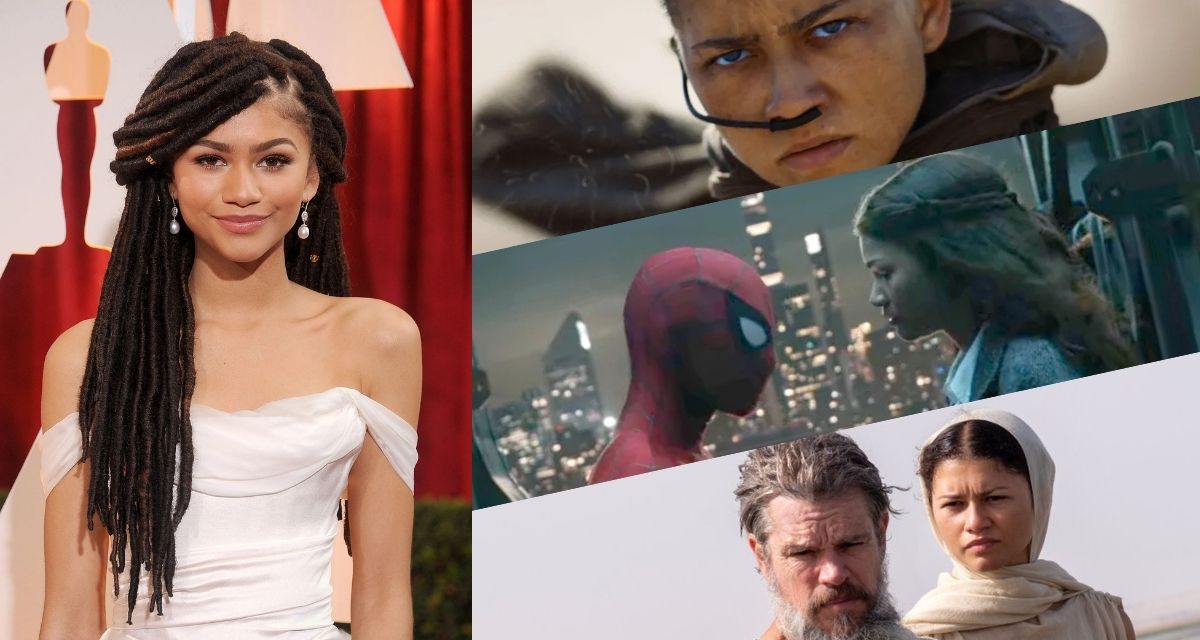
Not everyone gets to be the divine goddess Athena, a superhero’s love interest and Avengers ally, and a fierce Fremen warrior leading a rebellion on Arrakis all within one year. Zendaya does. And I honestly cannot think of many people who have managed to build a career this big while still feeling so completely like themselves.
With three massive movies trending right now, Christopher Nolan’s The Odyssey, Marvel’s Spider-Man: Brand New Day, and Denis Villeneuve’s Dune: Part Three, she is undeniably one of the biggest stars on the planet. But before she became an Emmy-winning powerhouse and a certified box office titan, she had to fight for something that should never have been difficult to receive in the first place. Basic respect.
To understand the kind of leader she is in the industry today, you have to look back to 2015.
Zendaya was just 18 years old. She was moving from her days as a Disney Channel star into the much bigger Hollywood spotlight, and she attended the Academy Awards wearing an elegant off-the-shoulder gown with her hair in gorgeous dreadlocks. Looking back at it, there is something especially meaningful about that choice. She was 18, standing on one of the biggest red carpets in the world, and instead of trying to make herself more acceptable, she chose to celebrate where she came from.
The next day, the media response was not about her talent, her confidence, or how beautiful she looked. On national television, a major host for E! News’ Fashion Police openly mocked her appearance, saying that Zendaya’s hair looked like it smelled of “patchouli oil or weed.”
It was a blatant racist microaggression broadcast to millions of people. And what makes it worse is how familiar the situation feels. A young actress is insulted publicly, and suddenly she is the one who has to be careful. Do not get angry. Do not make things worse. Do not risk your career. Just let it go. At 18, with Hollywood finally beginning to take notice of her, Zendaya had every reason to be afraid of what speaking up might cost her.
She wasn’t. Zendaya threw the playbook like it was last week’s grilled cheese sandwich.
She did not let a PR team turn her anger into some carefully cleaned-up statement. She went straight to social media and responded herself. And what I love about her response is that she did not stop at saying that the comment was rude. She understood that this was bigger than one person insulting her. It was another example of people judging Black hair and treating it as something that needed to be corrected, mocked, or explained.
She said: “There is already harsh criticism of African American hair in society without the help of ignorant people who choose to judge others based on the curl of their hair. My wearing my hair in locs on an Oscar red carpet was to showcase them in a positive light, to remind people of color that our hair is good enough.”
She also named highly successful and brilliant people who wear locs, from Ava DuVernay to her own father, and demanded that the media do better. She was only 18, but she already had enough confidence to understand that she did not need to apologize for something that was never wrong in the first place. I think that is what makes the moment so memorable. She was not asking people to approve of her. She was asking them to stop disrespecting her.
The impact was immediate and explosive. Zendaya’s response put a massive media network in a position where it had to answer for what happened, eventually leading to a very public, on-air apology from the host. But the apology was not the part that mattered most to me. What mattered was that an 18-year-old actress had taken something that could have been reduced to another celebrity controversy and turned it into a much bigger conversation about the way Black hair is treated and judged. She made people look at something they had become far too comfortable ignoring.
At just 18 years old, facing an industry machine that can be incredibly cruel to young women, Zendaya drew a hard line. She proved that you do not have to accept disrespect just because you are afraid of losing an opportunity. She protected her culture, her identity, and her peace. And there is something deeply satisfying about watching a woman who was once told, in one way or another, to make herself more acceptable grow into someone who clearly has no intention of doing that.
Today, she is at the absolute top of the Hollywood food chain, and she got there without letting other people write her story for her. She has officially become the highest-grossing actor of the year, with her recent films generating nearly $2 billion at the global box office. But her influence goes far beyond ticket sales. She has two Emmy Awards for her raw, devastating performance in Euphoria, dictates global fashion on her own terms, and is increasingly taking on producing roles so she can help build and shape the projects she actually wants to make. She went from an 18-year-old actress trying to find her place in Hollywood to someone who now has the power to decide what that place looks like.
Her story is a powerful reminder that your identity is not something other people get to debate. Sometimes you have to speak when staying quiet would be easier. Sometimes you have to protect the part of yourself that other people are trying to make you ashamed of. And sometimes, like Zendaya, you can look back years later and realize that the moment you refused to shrink yourself was also the moment you started becoming impossible to ignore.











0 Comments