
Close
by Lucy Harker | Aug 26, 2026
History is full of people who fought empires with armies and swords, but sometimes the most dangerous thing a person can have is a book. When we look back at the Middle Ages, it is easy to imagine that the people in power controlled everything, including what ordinary people were allowed to think. But in the 13th century, a French writer named Marguerite Porete showed just how frightening one person’s ideas could become when she refused to let anyone else control what she believed.
Marguerite was a Beguine, a woman who devoted herself to spiritual life and deep intellectual study without entering a convent. She lived independently, which alone was enough to make the male-dominated Church uncomfortable. But what really made her dangerous was what she chose to write.
She wrote a brilliant and radical book called The Mirror of Simple Souls. Instead of writing in scholarly Latin, which only educated elites could understand, she wrote in Old French. Her message was simple, but for the time, it was incredibly bold. She believed that a soul filled with divine love did not need the Church standing between it and God. You did not need bishops, strict rules, or people claiming to have control over your relationship with the divine. You just needed yourself.
For the medieval Church, that idea was terrifying. If people believed Marguerite, the institution would lose the power it had spent so much time building.
The Bishop of Cambrai condemned her work, publicly burned her book in the town square right in front of her, and gave her a choice. If she ever shared her ideas again, she would be declared a relapsed heretic, a crime punishable by death. I cannot imagine watching something you poured your mind and heart into being burned in front of you, then being told that speaking about it again could get you killed.
Most people would have watched their life’s work disappear into the fire, lowered their heads, and stayed quiet because staying alive mattered more. Marguerite did the exact opposite.
Instead of giving up, she spread her ideas even further. She made new copies of her book, translated it, and sent it to scholars and readers across Europe. She even sought out opinions from other intellectuals, completely ignoring the local bishop who had tried to silence her. She believed in the value of her work, and she refused to let a man with a title decide whether her thoughts were worth hearing.
Eventually, that defiance caught up with her. She was arrested by the Grand Inquisitor of France, taken to Paris, and thrown into a dungeon for a year and a half. The Inquisition demanded that she take an oath, answer their questions, and apologize for what she had written.
This is the part of Marguerite’s story that stays with me the most. Faced with one of the most terrifying and powerful tribunals in Europe, she chose absolute silence.
She refused to take their oath. She refused to say a single word to her interrogators. She understood that taking part in their trial would give them something they did not deserve, the appearance that they had the right to judge her mind. By remaining silent, she refused to play along. They could imprison her, threaten her, and eventually kill her, but they could not make her participate in her own submission.
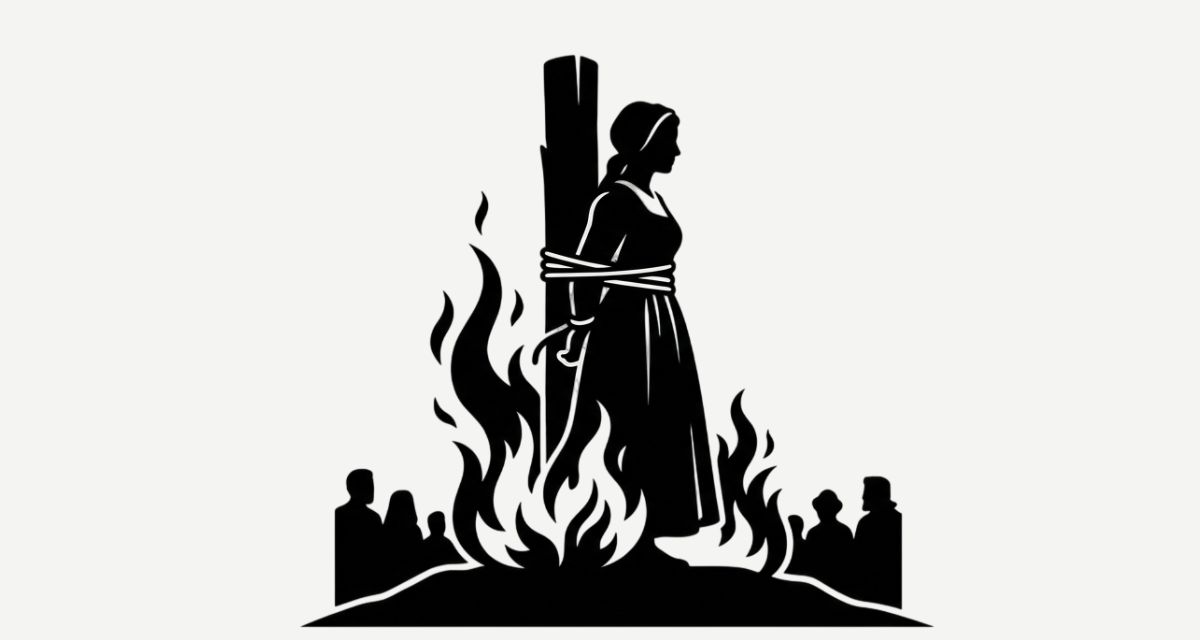
Frustrated and unable to make her bend, the Inquisition condemned her. On June 1, 1310, Marguerite was burned at the stake in Paris. Witnesses said that she went to the flames with such quiet dignity and without showing fear that people watching began to cry. There is something deeply heartbreaking about that image. After everything they had done to her, she still had one thing they could not take away from her: the way she faced them.
The Church tried to erase her name from history, but they failed. Her book was powerful enough to survive, passing secretly through Europe for centuries until modern historians finally restored her name to its cover. The people who wanted her ideas forgotten ended up helping create the very story that would keep her remembered.
Marguerite Porete’s story reminds me that sometimes we give too much power to people who have already decided that they do not want to understand us. We feel like we have to explain ourselves perfectly, defend every thought, and convince people who were never listening in the first place. Marguerite did not give them that satisfaction. She knew what she believed, and when they demanded that she surrender it, she simply refused. There is something incredibly powerful about that kind of silence. Sometimes you do not need to win the argument. Sometimes protecting your own mind means refusing to let someone else become the authority over it.
























0 Comments